Decoupling Content from Code: Strapi-Powered CMS Architecture
How we implemented Strapi as a headless CMS to decouple content management from frontend code - enabling faster publishing, zero deployments, and scalable content workflows for our entire team.

Introduction
Modern websites require frequent content updates - blog posts, product pages, landing pages, and marketing information. Traditionally, updating website content requires code changes, database schema updates, and full deployments. This creates a bottleneck where every content change becomes a developer task.
To solve this challenge, we implemented Strapi, a headless CMS that allows content to be managed directly through an admin panel - without modifying frontend code or database structures. This dramatically improves content agility, deployment efficiency, and team scalability.
With Strapi as the backbone of our content architecture, non-technical team members can publish, edit, and manage all website content instantly and independently - no developer involvement required.
What is Strapi?
Strapi is an open-source headless CMS that allows developers and content teams to manage website content through APIs. Instead of hardcoding content in the frontend, Strapi delivers dynamic content using REST or GraphQL APIs - making the content available to any frontend, any device, and any channel.
The term "headless" refers to the separation of the body (content management backend) from the head (frontend presentation layer). This decoupling gives teams complete freedom to use any frontend technology while the CMS remains the single source of truth for content.
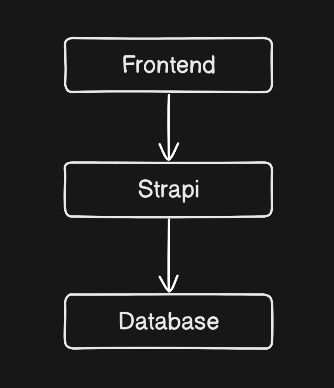
Strapi sits between the frontend and database, delivering content via API.
Problem With Traditional Content Updates
Before adopting a headless CMS, every content update required going through the full software development lifecycle. A simple text change on a landing page would trigger the entire engineering pipeline.
❌ Traditional Workflow
Content Change
→ Developer Updates Code
→ Database Migration
→ Testing & Review
→ Deployment
✅ With Strapi
Content Team
→ Strapi Admin Panel
→ Content Stored in DB
→ Website Fetches via API
→ Instant Update
Problems with the Traditional Approach
Slow Updates
Every content change cycles through lengthy development, review, and deployment pipelines - often taking days.
Developer Dependency
Content teams cannot publish independently. Every update requires developer time, creating bottlenecks.
Deployment Risks
Frequent code deployments for content changes increase the risk of regression bugs and service interruptions.
Poor Scalability
Marketing teams cannot scale content operations without proportionally growing the engineering workload.
Our Solution: Strapi-Powered Content Architecture
By introducing Strapi as our headless CMS layer, we transformed the content update workflow completely. The new architecture gives content teams full autonomy while maintaining a clean, API-driven separation between content and presentation.
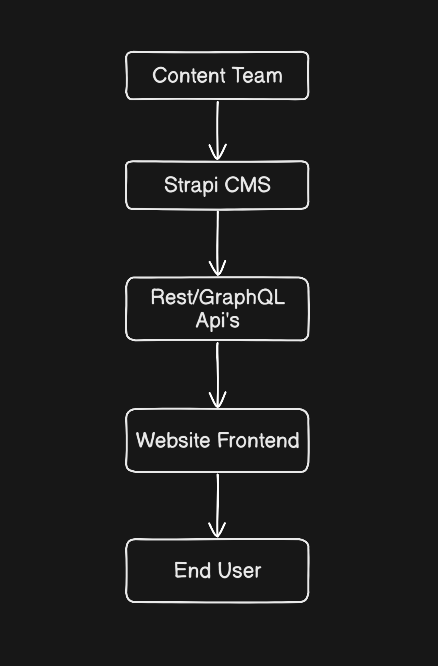
Content flows from the team through Strapi's APIs directly to the end user — no code changes needed.
Results of Our New Architecture
- No frontend code changes required for content updates
- No deployment required - content updates are live instantly
- No database schema modification for new content types
- Faster publishing - content can go live in minutes, not days
Key Features We Use in Strapi
Strapi provides a powerful set of capabilities that we leverage to manage all website content through a single, unified platform.
Dynamic Content Types
Define flexible schemas for any content structure without touching the database.
- Blogs & Articles
- Landing Pages
- FAQs & Product Sections
- Marketing Banners
API-Driven Content Delivery
Content is exposed through auto-generated REST and GraphQL APIs, ready to consume from any frontend.
GET /api/blogs
GET /api/pages
GET /api/productsRole-Based Access Control
Fine-grained permissions ensure each team member has exactly the access they need.
| Role | Access |
|---|---|
| Admin | Full access |
| Editor | Create / Edit |
| Viewer | Read only |
Media Management
Centralized media library for all digital assets, with built-in upload, organization, and optimization tools.
- Images & Videos
- Documents & PDFs
- Organized by content type
Business Benefits
The Strapi integration delivers measurable advantages across content operations, engineering efficiency, and team collaboration.
Faster Content Publishing
Content teams publish updates in minutes — no development cycle required.
Reduced Deployment Cycles
Fewer code deployments means fewer risks, lower infra costs, and more stable releases.
Better Scalability
Content operations scale without growing engineering headcount proportionally.
Improved Team Collaboration
Content, marketing, and engineering teams work in parallel without blocking each other.
Real-Time Website Updates
Published content is immediately available on the website with zero downtime.
Conclusion
By integrating Strapi as a headless CMS, we created a flexible and scalable content architecture that fundamentally changes how our team manages website content. The API-driven approach decouples content from code, empowering non-technical users while maintaining a modern, developer-friendly architecture.
This allows teams to publish content quickly, reduce development overhead, and empower non-technical users — while maintaining a modern, API-driven website that can evolve independently on both the content and engineering fronts.
Key Takeaway
Separating content from code isn't just an architectural preference — it's a strategic business decision. With Strapi, content becomes a first-class citizen, independently managed, instantly published, and infinitely scalable.