From Chatbots to Digital Employees: The Rise of Agentic AI & Multi-Agent Systems
The AI narrative is shifting - from passive prompt-response models to autonomous systems that perceive, plan, and execute. Discover the technical architecture, decision frameworks, and engineering principles behind building intelligent agent systems.
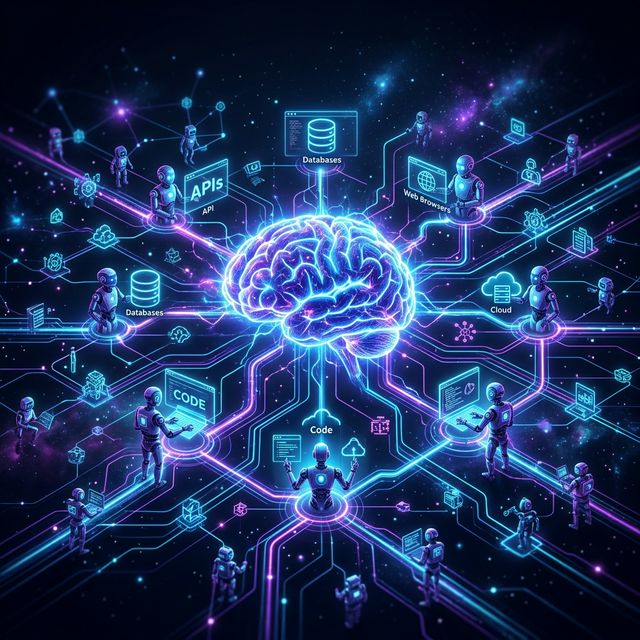
Abstract: We are moving away from passive models that simply answer questions toward Agentic Systems that autonomously execute complex goals. This blog explores the technical layers of Agentic AI, the engineering rationale behind Multi-Agent Systems (MAS), and a practical framework for deciding when, and how, to deploy them.
Beyond the Prompt: A Paradigm Shift
For the last few years, we have lived in the era of the "Prompt." Generative AI has been a spectacular tool for content creation — but it remains fundamentally passive. You ask, it answers, then it stops. The interaction ends the moment the response is delivered.
Agentic AI marks the end of passivity. These systems perceive their environment, create a multi-step plan, use external tools (APIs, Databases, Browsers), and iterate based on real-time feedback. They are not just "calculators for words" — they are Digital Employees.
The transition from Generative AI to Agentic Systems represents a monumental leap from passive content generation to proactive, autonomous problem-solving. While traditional Gen AI responds to user prompts, Agentic AI perceives, plans, and executes complex goals independently.
The key distinction: Generative AI is a tool you use. Agentic AI is a colleague that works alongside you — reasoning through ambiguity, using tools, and iterating until the goal is achieved.
The AI Capability Spectrum
Understanding the hierarchy of AI capability is the first step for any architect. There are three distinct tiers, each with fundamentally different capabilities, use cases, and engineering requirements.
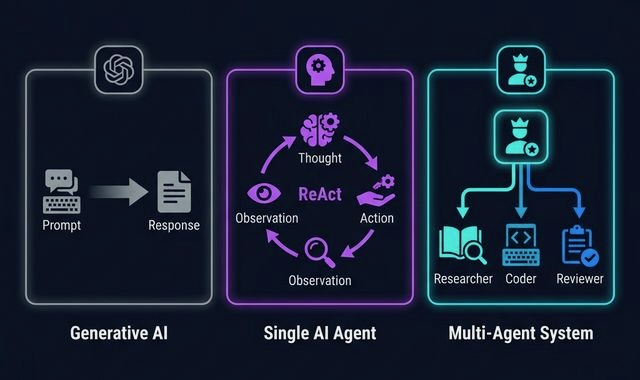
The three tiers: passive Generative AI, active Single Agents using ReAct loops, and collaborative Multi-Agent Systems.
| Feature | Generative AI | Single AI Agent | Multi-Agent System |
|---|---|---|---|
| Core Goal | Create Content | Execute a Specific Task | Orchestrate a Broad Goal |
| Logic | Next-token prediction | Iterative ReAct loops | Distributed reasoning |
| Nature | Passive | Active (Tool Use) | Collaborative (Teamwork) |
| Human Role | Constant Prompting | Managerial Oversight | Strategic Director |
The Power of the Loop: How Agents Think
Traditional AI follows a linear path: Input → LLM → Output. An agent, by contrast, lives in a Reasoning Loop. This is most commonly implemented as the ReAct pattern (Reason + Act), which dramatically increases the quality of output for complex, multi-step tasks.
"I need to find the user's latest invoice and check payment status."
Calls SQL_Search_API with invoice query parameters.
"Invoice found: INV-2024-0847, Status: Unpaid, Due: 14 days ago."
"I will now draft an overdue payment reminder and check payment history."
The ReAct loop: agents reason, act on tools, observe results, and refine — iteratively working toward the goal.
Why Multi-Agent? The Engineering Case
A common question is: "Why not just use one giant agent?" The answer lies in engineering constraints, not just expertise. Single agents running long tasks face fundamental resource limitations that multi-agent architectures are designed to solve.
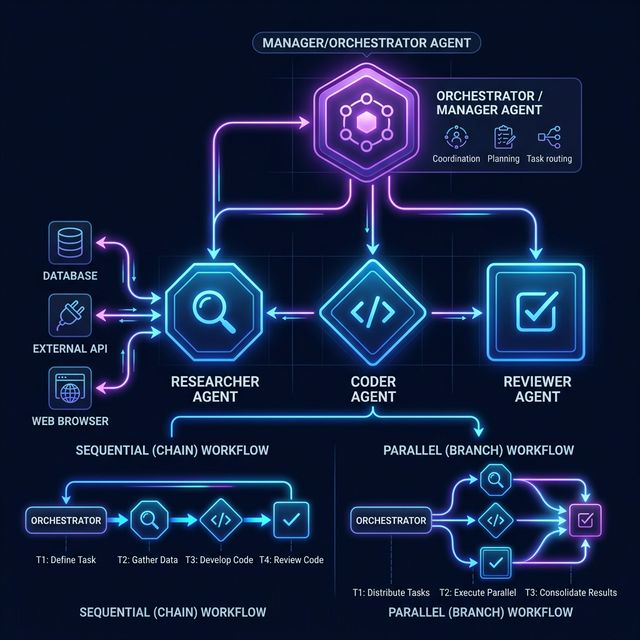
A Manager Agent orchestrates specialized workers — each with focused context and purpose-built tools.
Three Core Engineering Advantages
Context Management
Single agents suffer from Context Dilution — they forget early rules as chat history grows. MAS uses Distributed Context, keeping each agent hyper-focused on its specific data segment.
Tool Precision
Giving 50 tools to one agent is a recipe for hallucinations and Tool Confusion. MAS assigns 2–3 targeted tools to each specialized agent, reliably increasing accuracy to 99%.
Parallel Processing
Single agents process tasks linearly. MAS enables parallel branches — like Researcher A and Researcher B working simultaneously — dramatically reducing end-to-end time.
Classical Agent Types
Modern agent design is rooted in five classical types defined by Russell & Norvig. Understanding these archetypes helps engineers choose the right reasoning model for each task within a MAS.
Acts based on current perception only. Logic: If X, then Y. Best for deterministic, rule-based automation — fast and reliable in well-defined environments.
Maintains an internal world model, keeping track of state over time. Handles partially observable environments where past context matters.
Plans backward from a target destination. "What steps do I need to take to reach goal G?" — ideal for multi-step reasoning.
Optimizes for the best path across multiple criteria (speed, cost, safety). Uses utility functions to weigh trade-offs and select the optimal action.
Improves performance through experience and feedback analysis. The foundation of self-improving AI systems that adapt over time.
Strategic Decision Framework: When to Use Agents
Implementing agents adds architectural complexity. Use the following framework to decide whether an agent is the right tool, and which tier of the AI spectrum to deploy.
✅ Use an Agent When
- Multi-Step Workflows: Tasks requiring sequential reasoning (e.g., Research → Analyze → Write → Publish).
- Tool Integration: When the AI must interact with external systems — Databases, APIs, Web, file systems.
- Dynamic Environments: When the path to the solution must adapt based on real-time discoveries.
- Complex Orchestration: When multiple specialized skills need to work together toward a broad goal.
❌ Avoid Agents When
- Simple Tasks: Basic translations or summaries — standard LLM calls are faster and dramatically cheaper.
- Latency-Sensitive: Real-time apps like instant search — use deterministic scripts instead.
- Mission Critical Math: Structural engineering or financial calculations — hallucinations are catastrophic here.
- High-Cost Loops: If token cost per iteration exceeds the value delivered by the task.
Start with a single agent or a standard workflow. Move to Multi-Agent Systems only when Context Dilution or Tool Confusion begins to degrade performance.
Technical Trade-offs: Single Agent vs. MAS
Choosing between a single agent and a multi-agent system is an architectural trade-off. Here's a detailed breakdown of the key engineering considerations.
| Dimension | Single Agent | Multi-Agent System |
|---|---|---|
| Context Window | Risk of context dilution over long tasks | Distributed context — each agent stays focused |
| Tool Use | Tool confusion with 10+ tools | 2–3 tools per agent, high reliability |
| Processing | Sequential (one task at a time) | Parallel branches possible |
| Complexity | Simpler to build and debug | Higher orchestration complexity |
| Cost | Lower token cost per task | Higher initial cost, but scales better |
| Best For | Focused, well-scoped tasks | Ambiguous, expansive goals |
Reliability Engineering: Solving Hallucinations
LLMs are probabilistic engines, not factual databases. Hallucinations occur when the model "fills the gaps" with plausible but incorrect information. In agentic systems — where an agent might take real-world actions — a hallucination can have serious downstream consequences.
The solution is Context Engineering: a set of deliberate design patterns that anchor the AI in verified information and reduce the probability of confabulation.
The 4 Pillars of Context Engineering
Select
Use RAG (Retrieval-Augmented Generation) to pull only relevant data into the context window. Don't flood the agent — curate its focus.
Compress
Summarize long conversation histories into executive summaries to keep the context window clean and prevent early-context forgetting.
Write
Utilize hidden scratchpads — allow the agent to think and plan before providing a final output. Structured reasoning before response.
Isolate
Compartmentalize data between agents. The Coder agent gets only code. The Tester gets only requirements. Isolation eliminates cross-contamination.
Design Tip: Implement Multi-Agent Debate to reach consensus-based accuracy. Agent A proposes an answer; Agent B acts as a critic. They "argue" — iterating until they converge on a verified, cross-validated result. This pattern dramatically reduces hallucination rates in critical workflows.
Memory & Communication Architecture
Agentic systems require a thoughtful memory architecture. Unlike stateless LLM calls, agents must maintain context across steps, remember past interactions, and share information across agent boundaries.
Memory Layers
Short-Term (Sensory)
The immediate context window — the agent's "RAM." Fast but limited in size. Used for active reasoning within the current conversation turn.
Working Memory
Chain-of-thought scratchpads for current reasoning. Allows the agent to "think out loud" before committing to a final answer or action.
Long-Term (Semantic)
Facts stored in Vector Databases via RAG. Enables retrieval of domain-specific knowledge beyond the training data cutoff.
Long-Term (Episodic)
Historical interaction data — user preferences, past decisions, learned patterns. Enables personalization and continuous improvement.
Communication Models
Direct (P2P)
Agent A hands results directly to Agent B. Simple and low-latency — best for linear pipelines with clearly defined hand-off points.
Blackboard Pattern
All agents read and write to a central shared state. Flexible for asynchronous, parallel workflows where agents consume results when ready.
Supervisor / Orchestrator
A Manager agent directs all traffic, assigns tasks, and prevents infinite loops. Best for hierarchical systems with complex task dependencies.
Operational Patterns: Workflow Logic
The Hybrid Systems approach is the most robust production pattern: use deterministic code for the "tracks" (orchestration) and AI agents for the "train" (reasoning). This provides both predictability and intelligence.
🔗 Sequential (Assembly Line)
Research
→ Analyze
→ Write
→ Review
→ Publish
Best for well-defined, predictable pipelines with clear handoffs.🏢 Hierarchical (Corporate Office)
Manager Agent
→ Assigns Researcher
→ Assigns Writer
→ Verifies Output
→ Delivers Result
Best for ambiguous, expansive goals that require dynamic task allocation.Key Implementation Considerations
Building production-grade agentic systems requires careful attention to these critical engineering challenges. Each one can make or break the reliability of your deployment.
Tool Design
Design tools with strong schemas and clear descriptions. The agent's ability to use tools effectively depends entirely on how well the tools are documented.
- Unambiguous function signatures
- Explicit error return types
- Input validation on every tool
Context Window Budget
Every token costs money and impacts latency. Implement context budgeting — compress, summarize, and prune aggressively to keep agents efficient.
- Rolling summary windows
- Relevance-filtered RAG
- Selective memory retention
Loop Termination
Infinite loops are the most common failure mode in agentic systems. Implement hard stop conditions, max iteration budgets, and circuit breakers.
- Max iteration limits
- Goal completion validators
- Escalation to human review
Observability
Agentic systems are harder to debug than standard software. Invest heavily in tracing, logging, and monitoring at every step of the reasoning loop.
- Per-step reasoning logs
- Tool call auditing
- Latency and cost dashboards
Governance: Human-in-the-Loop (HITL)
Autonomy does not mean "unsupervised." The most successful enterprise agentic systems implement The Guardrail — a strategic set of human approval checkpoints for high-stakes decisions.
This ensures that for high-risk actions — like moving money, deleting data, or sending external communications — the agent pauses and waits for a human "Approval Gate" before proceeding.
Approval Gates
High-risk actions (financial transfers, database deletions) require explicit human sign-off before execution.
Audit Trails
Every action the agent takes is logged with its reasoning, enabling review, compliance, and debugging.
Override Capability
Humans can intervene, redirect, or halt the agent at any point during execution — full control is always retained.
Performance Review
Regular review cycles ensure agents are performing within acceptable bounds and improving over time.
Conclusion
The move to Agentic AI is a shift from LLMs as chatbots to LLMs as reasoning cores. These systems don't just generate words — they make decisions, use tools, and take meaningful actions in the world.
By understanding the trade-offs between sequential and hierarchical architectures, respecting the limitations of context windows, and engineering for reliability through context engineering and HITL governance, engineers can build systems that don't just talk about work — they do it.
Key Takeaway
Start simple. Build a single agent with one tool and one clear purpose. Validate its performance exhaustively. Only then expand to multi-agent orchestration when complexity demands it. The best agentic systems are engineered with discipline, not enthusiasm.
Coming Next: Building your first Multi-Agent System with Python and LangGraph — a hands-on implementation guide covering orchestration, tool design, memory management, and deployment.